AI travel stylist

The plan before you pack.

Tell it where you're going, when, and what you'll be doing. It dresses every day against the real forecast and the local dress code — out of the clothes you already own — and the packing list falls out of it.

See what it does iPhone · coming to the App Store
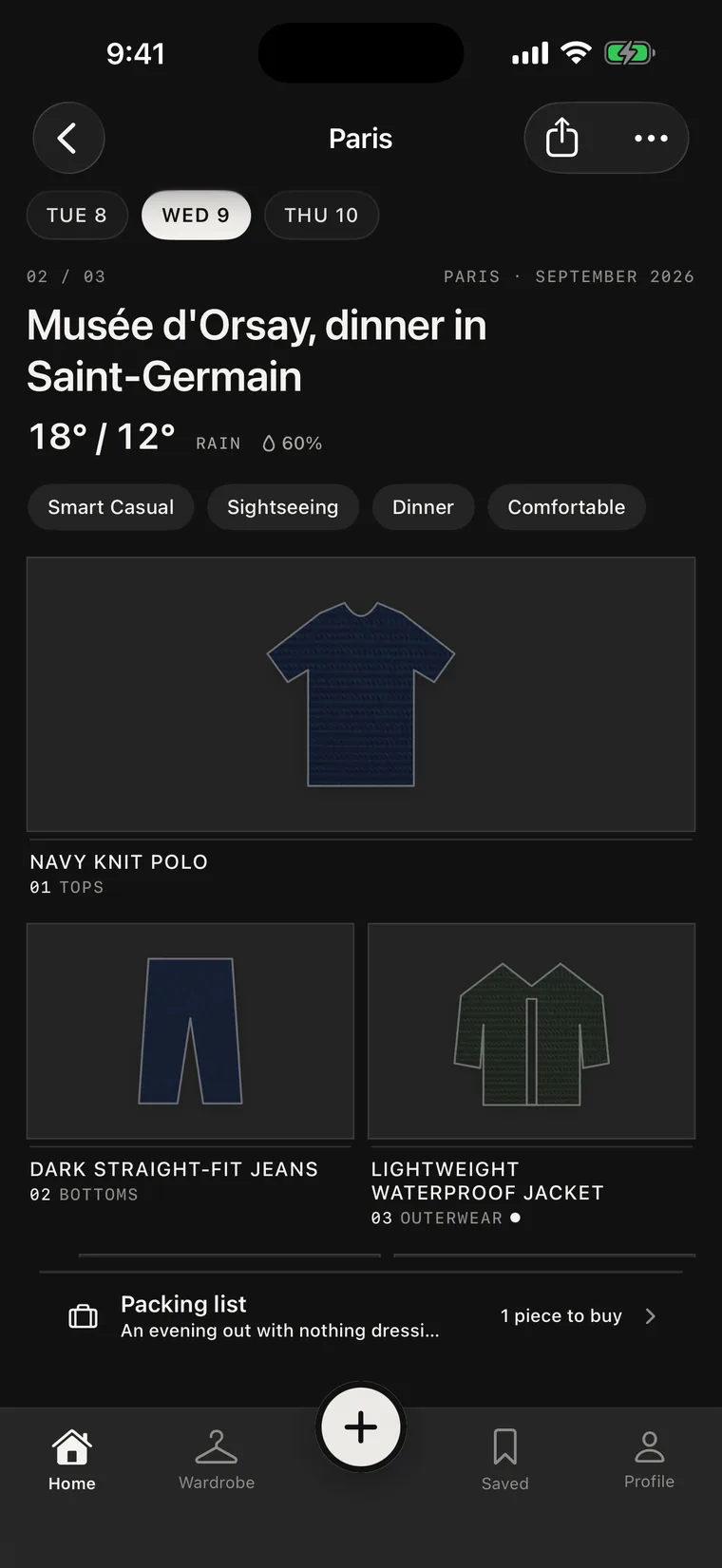
A day of a trip plan: Musée d'Orsay, dinner in Saint-Germain, 18°/12°, with the day's outfit laid out.

The fold

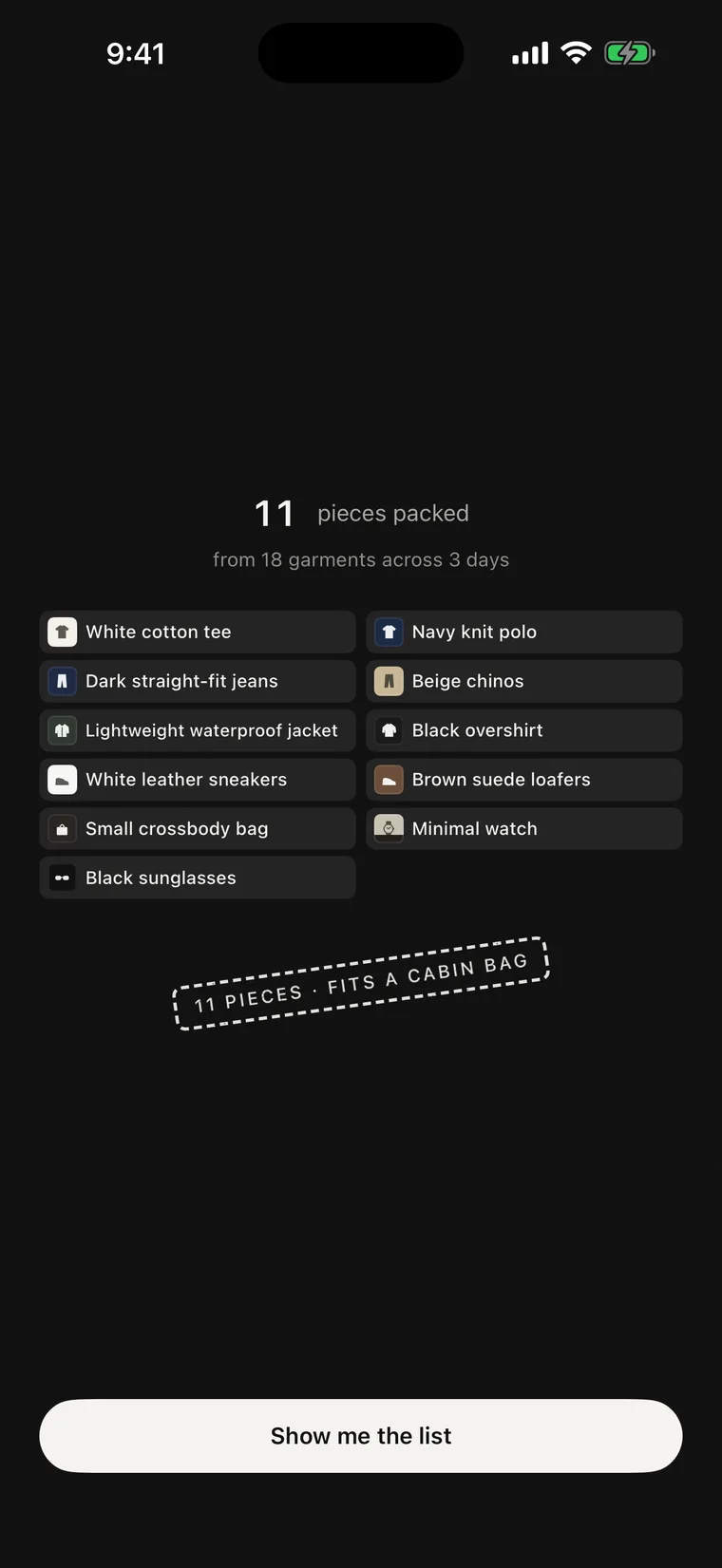
Eighteen garment-slots. Eleven pieces.

Every day gets a complete outfit. Then the plan folds: a piece worn on Monday and again on Wednesday is one thing in the bag, not two. That collapse is the whole product, and it runs on your actual trip — not on a demo.

18

garment-slots across three days

11 pieces · fits a cabin bag

How it works

Three steps, and you do one of them.

01

Name a place

The field is the first thing you see. Pick a city and the page fills itself in — the real three-day forecast, the country's dress rule if it has a reviewed one, and a capsule sized to that weather. Ten seconds, and no model has been asked anything yet.

02

It dresses every day

Weather, what you'll be doing, the local register, and your own wardrobe first. A minute or so — and the days appear as they're written, so you start reading day one while day seven is still being drafted.

03

It packs the bag

The list is derived from the plan, so the two can't disagree. Add the things that aren't clothes — shampoo, passport, charger — and it offers them back on your next trip.

What it answers

Not “what's cute”. What you'll actually need.

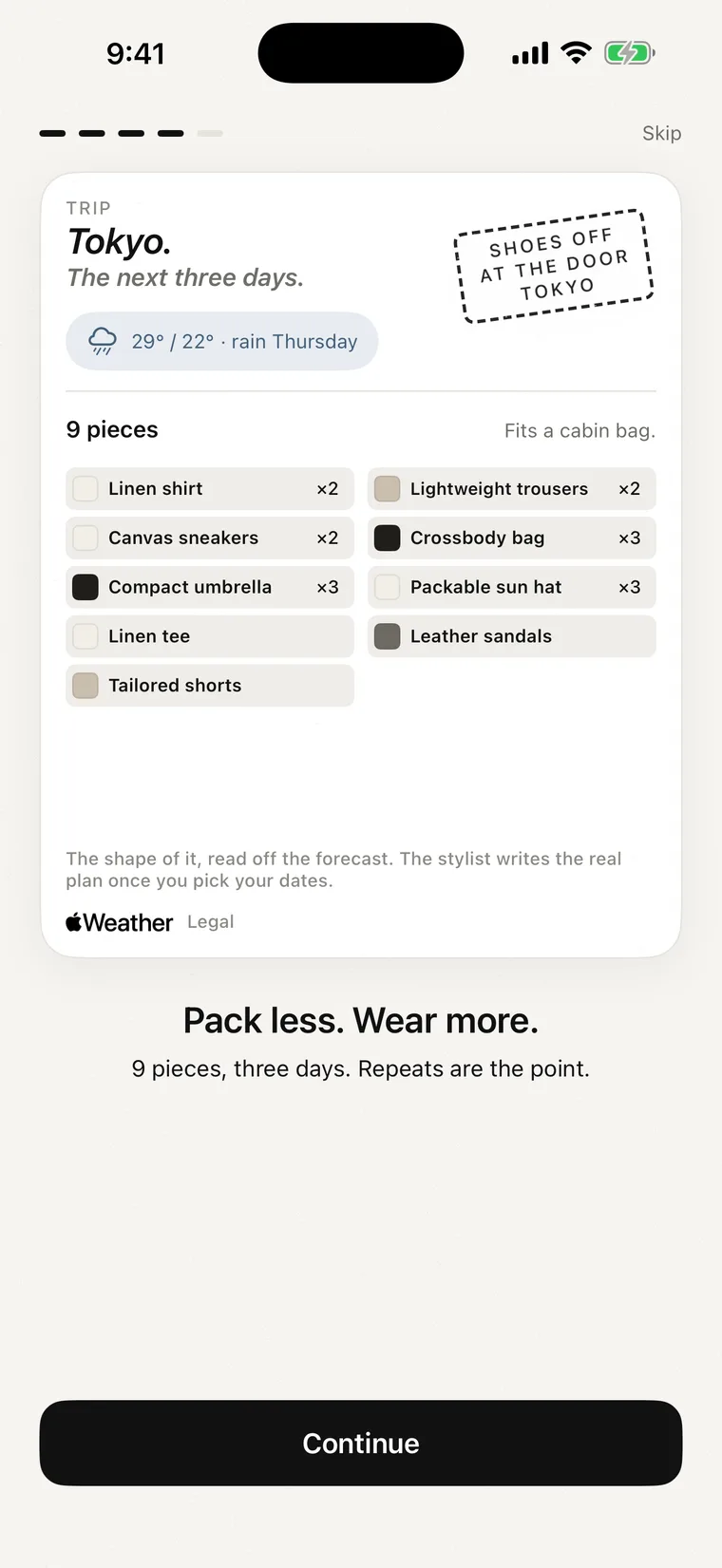
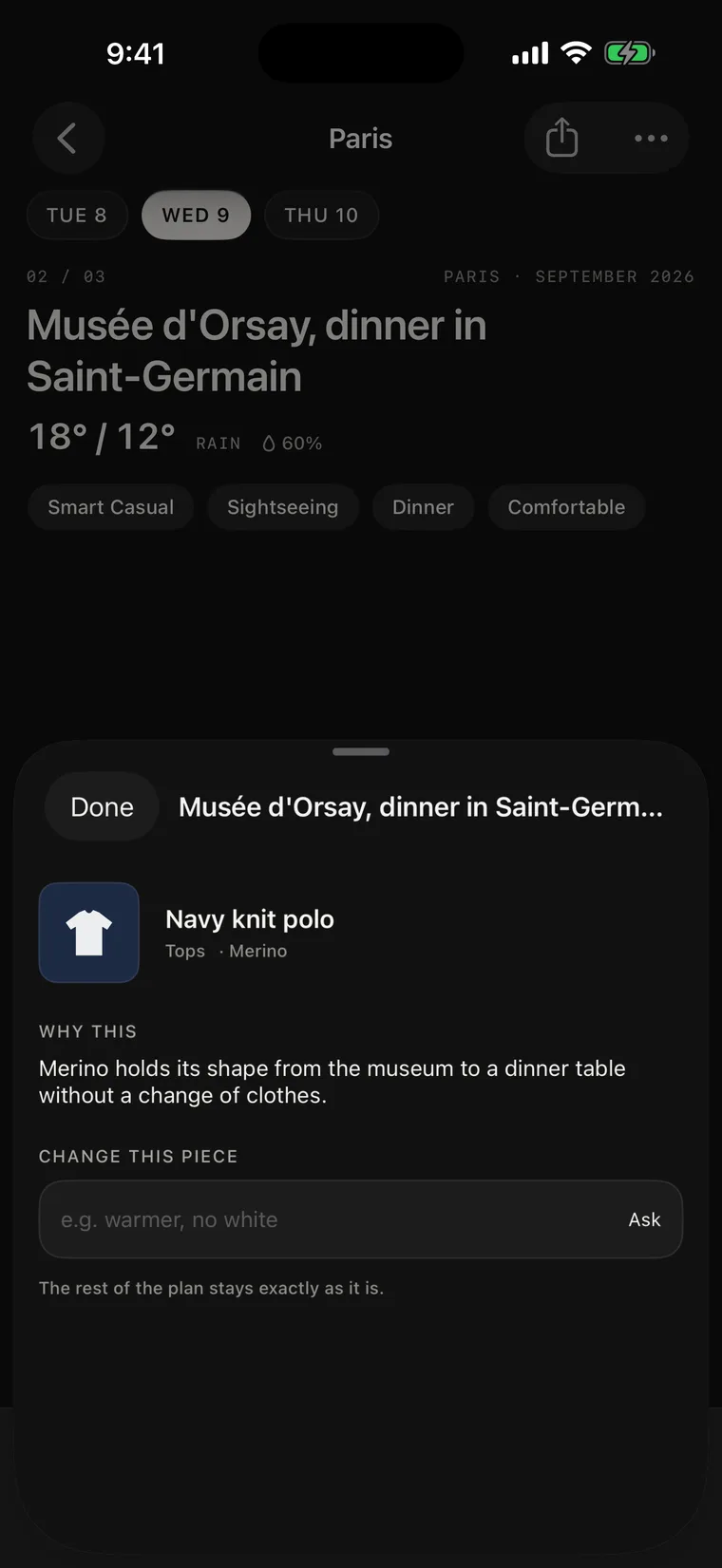
Tokyo, its three-day forecast and a capsule sized to it. The stylist explaining why a merino polo was chosen. Eleven pieces packed, from eighteen garments across three days.

Ten seconds, not forty.

Name a city and the page fills itself in: the real three-day forecast, the country's reviewed dress rule, and a capsule sized to that weather. No account, no wardrobe to photograph first, no model call — before you've decided anything.

It says why.

“Merino holds its shape from the museum to a dinner table without a change of clothes.” Every piece can explain itself, and any one of them can be swapped for something you already own.

Then it packs the bag.

The packing list is derived from the plan, so it can't disagree with it — and it holds the things that aren't clothes too. Shampoo, passport, charger. Add your own; it remembers them for next time.

The verdict

Every line is checked, never claimed.

The night before a trip the question isn't what's fashionable. It's whether you'll be the one in shorts at the cathedral, or freezing at dinner. So the app says what the plan handles — and what it doesn't.

Covered

  • One day of rain, and outerwear for it.
  • One day carries a local dress rule, written into the day.
  • UV 6, and there's sun cover in the bag.
  • Every piece works past one wash.
  • 11 pieces — fits a cabin bag.

Not covered

  • An evening out with nothing dressier than daywear.
  • One piece you don't own yet.

A dry trip says nothing about rain, rather than “no rain expected”. A check that can't be made honestly isn't made.

It remembers

“Left out the black overshirt — you packed it last time and didn't wear it.”

And only when that is true. The app checks that the piece was actually reported unworn and is genuinely absent from the new plan. If the stylist kept it anyway because the weather demanded it, the app says nothing rather than taking credit for a decision it didn't make.

Your wardrobe

One photograph. Every garment in it.

The loudest complaint about apps like this is the cataloguing tax — being made to do an afternoon of work before the app does anything. So take one mirror shot and it reads up to eight pieces out of it at once, cropping each one to its own tile.

It costs one credit, not eight

One photograph is one model call however many garments come back. Charging per piece would price the fix out of the free tier — which is exactly where the complaint comes from.

A wrong crop is worse than no crop

If the box the model returns is implausible — inverted, off the frame, a sliver, or covering the whole photo — the crop is skipped and the full picture is kept. It's a picture of your own clothes; it has to be right or not attempted.

Your closet is never a precondition

Plans are generated from an empty wardrobe. Add pieces whenever you like and the stylist reaches for them first.

A garment's detail sheet, with the stylist's reasoning and a way to swap it.

Why it's different

Three things a closet app can't do.

01

It knows where you're going

A wardrobe app has your clothes and no destination. A packing app has a checklist and no idea what clothes mean. This has held both all along.

02

It packs for two

Every app in this category is a closet for one person — fair for a wardrobe, poor for a suitcase. Add whoever you're travelling with: two capsules, two bags, one forecast.

03

It tells you to buy nothing

Before suggesting a purchase it looks for something you already own that plays the same role. A shopping feature whose best outcome is spending nothing.

Plainly

What it asks of you.

No accountNo sign-up, no email, no password. Nothing to restore and nothing to leak.
6 languagesEnglish, German, French, Spanish, Italian and Japanese — the plan itself is written in yours.
On deviceTrips, wardrobe and photos stay on your phone. What the stylist needs is sent only after you agree, and you can change your mind.
One tapDelete everything. Photos go first, while the records naming them still exist.

Questions

The ones worth asking.

Do I have to photograph my wardrobe first?

No, and you never do. A plan is generated from an empty closet. Adding pieces makes the plans better — the stylist reaches for what you own before it suggests anything — but it has never been a precondition.

Where does the weather come from?

Apple WeatherKit. Inside the ten-day window it's the real forecast; beyond it, the same calendar dates averaged over the previous three years, labelled “Typical” so you know which one you're reading. If there's no forecast for a place, the app says so instead of inventing one.

What about the local dress codes?

Only countries with a reviewed note get one, and the app can only show rules from a fixed set it ships with — it cannot render a claim about a place that hasn't been reviewed, even if a server told it to.

Does it work on a plane?

The plan, the packing list, your wardrobe and its photos are all on the phone, so most of the app does. Generating a new plan needs a connection, and it tells you that in about a tenth of a second rather than timing out into a vague error.

What does Pro add?

Full-length plans for the whole trip, unlimited plans, no cap on your wardrobe, regenerating any day with feedback, a render of an outfit on a photo of you, and a second traveller with their own capsule and their own bag.

Pack less. Wear more.

One plan, one capsule, one bag — and an honest list of what it doesn't cover.

See how it works iPhone · coming to the App Store